


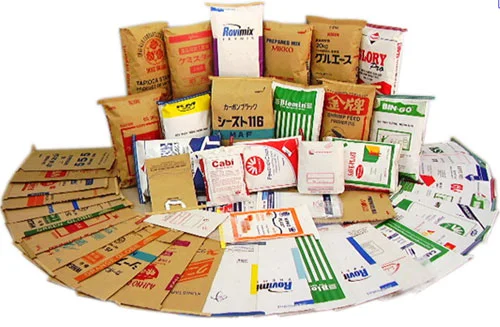
In the food and pharmaceutical industries, food packaging is not just a container for products. It directly affects product quality, safety, and consumer trust. However, many businesses still choose packaging based on intuition or cost-saving priorities, overlooking quality factors. This leads to risks such as product damage, increased costs, and reduced brand value.
This article highlights common mistakes in choosing food packaging while providing practical solutions to help businesses optimize their packaging strategies, including sealing films and desiccants.
Common Mistakes Businesses Make When Choosing Food Packaging and How to Fix Them
Many business owners still believe that packaging only needs to be able to contain the product. This is a serious misconception. In reality, food packaging is an integral part of a comprehensive protection system. It works in combination with sealing films, desiccants, and proper storage conditions to maintain product quality from the factory to the end consumer. When the wrong packaging is chosen, all subsequent protective solutions become far less effective.
6 Mistakes and Fixes Businesses Commonly Face When Choosing Food Packaging
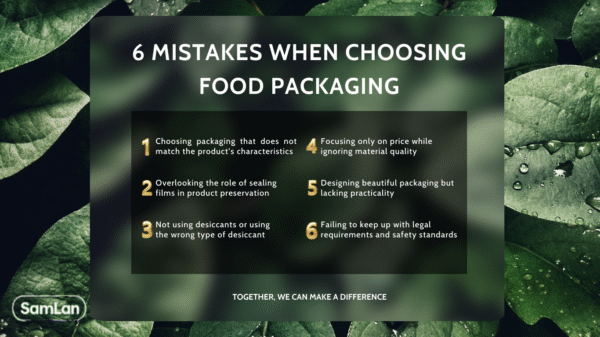

Choosing packaging that does not match product characteristics
This is the most common mistake and also the one with the most serious consequences. Each type of food has different characteristics and reacts differently to environmental factors. For example, oxidized foods, products prone to moisture absorption, or those that deteriorate when exposed to light.
Many businesses choose packaging based on what is readily available in the market. This approach often ignores the specific needs of the product, leading to issues such as discoloration, odor changes, or spoilage during storage.
How to fix it:
Businesses need to clearly identify their product characteristics. Is it sensitive to moisture, oxygen, light, or microorganisms? Based on this, choose appropriate food packaging. In many cases, packaging should be combined with sealing films to improve product protection efficiency.
Focusing only on price and ignoring material quality
To cut costs, many businesses prioritize cheap packaging. However, low-quality packaging materials often lead to higher long-term costs. Packaging may tear, deform, or fail to seal properly, causing product loss and damaging brand reputation.
How to fix it:
Instead of comparing prices alone, businesses should compare total lifecycle costs. High-quality packaging reduces defect rates, minimizes returns, and protects brand image. In the long run, the cost per unit is often much lower than cheap alternatives.
Designing beautiful packaging but lacking practicality
Businesses often invest heavily in eye-catching designs to stand out on shelves. However, if packaging is difficult to open, hard to store, or incompatible with production lines, it creates inconvenience for both consumers and operations. Some attractive designs fail to fit automated packaging lines, slowing down production and increasing costs.
How to fix it:
Packaging design must balance aesthetics and functionality. Businesses should test packaging on real production lines and consider actual consumer experiences. The best food packaging is packaging that is easy to use, not just visually appealing.
Ignoring the role of sealing films in product protection
Many businesses believe that tight packaging is enough. This is especially common with bags, bottles, or jars that do not use sealing films. As a result, products can be exposed to oxygen and moisture. For fresh food, nuts, or dried products, sealing films play a critical role in preventing contamination and extending shelf life.
How to fix it:
Sealing films should be considered an essential part of the food packaging system. Choosing the right sealing film based on packaging materials and sealing methods helps maintain airtightness and enhances consumer confidence.
Read more: 3 Tips for Using Seal Liners Effectively
Using desiccants incorrectly or choosing the wrong type
Moisture is the silent enemy of most food and pharmaceutical products. However, many businesses underestimate its impact or select desiccants with unsuitable absorption capacity. In some cases, desiccants absorb moisture too slowly or become ineffective too quickly.
How to fix it:
Businesses need to evaluate storage environments and distribution conditions. From there, choose desiccants with appropriate absorption capacity. Combining desiccants with proper food packaging helps maintain product quality throughout the supply chain.
Not complying with safety and legal standards
Food packaging is not just a marketing tool. It directly affects food safety. Using non-compliant materials or failing to meet regulatory standards can lead to product recalls and serious legal risks.
How to fix it:
Businesses must stay updated on food packaging regulations. Packaging materials should meet safety standards and be clearly labeled. Compliance not only avoids legal issues but also builds trust with consumers.
Sam Lan – Comprehensive Product Protection Solutions from A to Z


Sam Lan is a leading provider of food packaging solutions, specializing in sealing films and desiccants. These solutions help businesses avoid common packaging mistakes such as poor airtightness, moisture absorption, or product degradation during storage and transportation.
For dried foods, pharmaceutical products, and fresh produce, sealing films act as the final protective barrier. When combined with suitable packaging materials, sealing films significantly improve sealing performance and reduce exposure to external oxygen and moisture.
At the same time, Sam Lan’s desiccants help control internal humidity an especially critical factor for nuts, dried foods, and pharmaceuticals. When food packaging is properly combined with sealing films and desiccants, businesses can significantly reduce defect rates and extend product shelf life.
Choosing a solution provider like Sam Lan allows businesses to approach product protection as a complete system rather than isolated components.
Conclusion
Choosing the right packaging is an investment, not a cost.
Food packaging is a core part of product quality strategy. When selected correctly, it enhances product value and brand credibility. When chosen poorly, it can become a long-term liability.
Businesses should adopt a holistic product protection approach integrating packaging, sealing films, and desiccants into one unified system. Partnering with Sam Lan today ensures tailored solutions for every product category and helps businesses build a sustainable competitive advantage.